
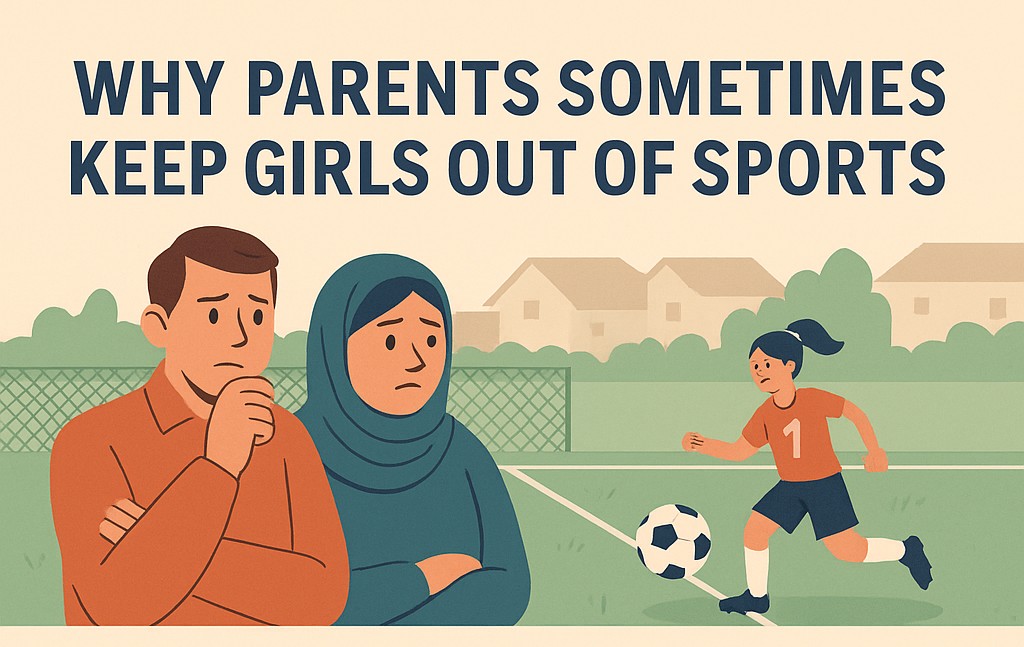
Safety & Honor Concerns
Many parents worry about their daughters’ physical safety and the potential impact on family reputation in more conservative settings:
Fear of Injury or Harassment
Concerns about concussions, broken bones, or harassment—particularly in co‑ed facilities—can lead parents to steer girls away from contact or evening practices.
Suggested image: A mother watching her teenage daughter train on a football pitch, looking apprehensive (alt: “Parent observing training from sidelines”).Protecting Family “Honor”
In some communities, a girl’s public visibility—competing in shorts or mixing with boys—can be seen as risking family reputation. Parents may restrict participation to avoid gossip or sanction.
Suggested image: A family discussion around a dinner table, illustrating cultural dialogue (alt: “Family talking about sports participation”).
Opportunity Cost & Priorities
When time and resources are limited, sport can be seen as competing with other “more important” pursuits:
Academic Performance or Early Marriage Expectations
In many cultures, excelling in school or preparing for an arranged marriage takes precedence over what is viewed as a “non‑essential” activity. Extra tutoring or household training often cuts into practice time.
Suggested image: A girl balancing schoolbooks and a soccer ball, symbolizing competing priorities (alt: “Student athlete debating time allocation”).Household Duties vs. Practice Schedule
Girls are frequently expected to contribute to chores—cooking, cleaning, childcare—leaving little time or energy for regular training sessions or travel to matches.
Suggested image: A young woman helping with laundry before heading to practice (alt: “Balancing chores and sport”).
Lack of Role Models & Support
Without visible pathways, both girls and their parents can feel that sport is simply “not for us”:
Few Local Female Coaches or Mentors
When the only coaches around are men, parents may mistrust mixed‑gender locker rooms or question whether a sport is “appropriate.” Having female mentors—coaches, physios, former athletes—helps normalize participation.
Suggested image: A female coach demonstrating a drill to a small group of girls (alt: “Women coaching girls’ team”).No Clear Transition from School to Club
If there’s no local women’s league, college scholarship route, or clear “next level,” parents may see sport as a dead end rather than a potential opportunity.
Suggested image: Empty seats at a local girls’ league match, illustrating under‑investment (alt: “Sparse crowd at women’s local game”).