
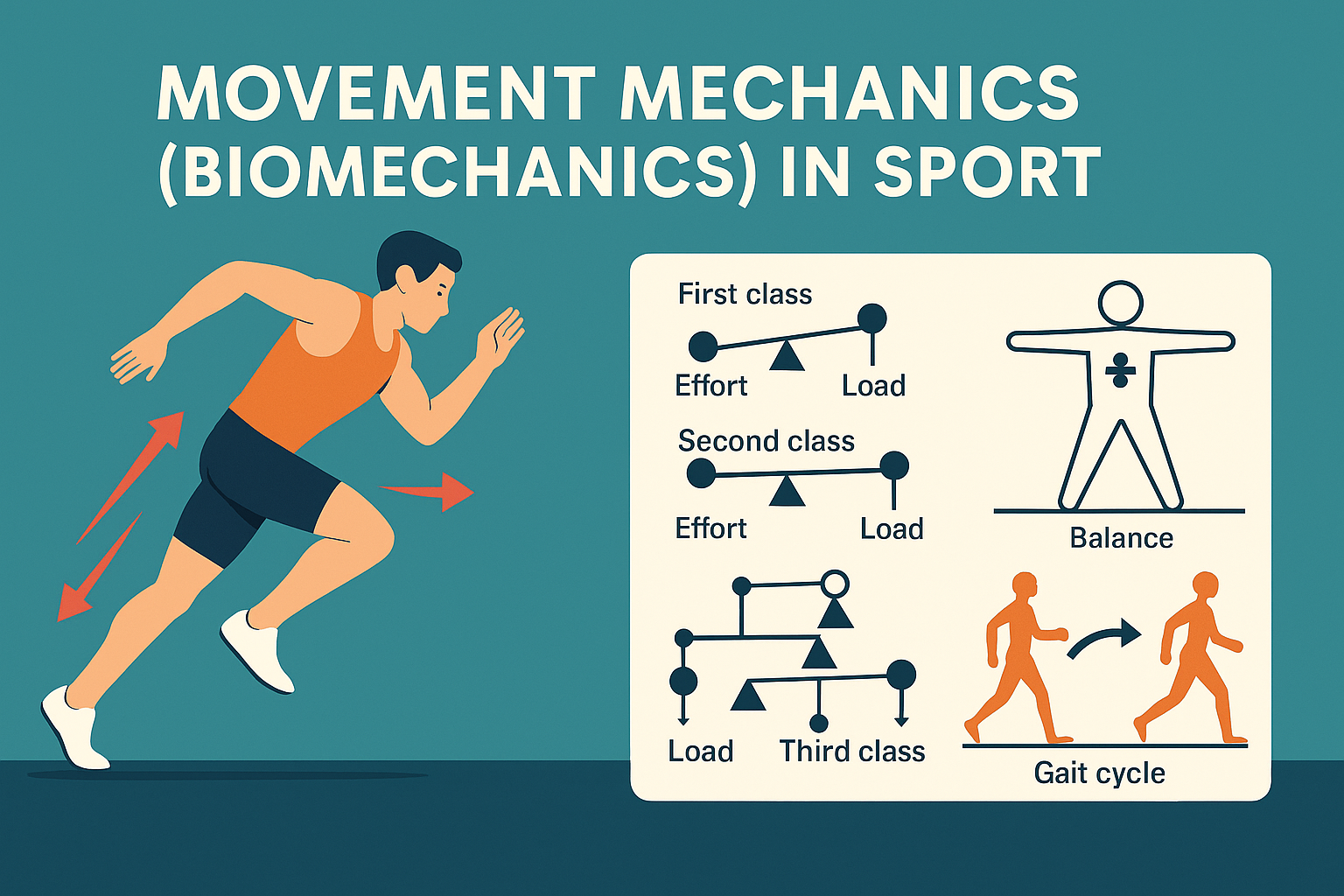
Biomechanics is the science of movement. In sports, it helps athletes optimize technique, enhance efficiency, and reduce injury risk by analyzing how the body moves under various conditions.
What Is Biomechanics?
Biomechanics applies principles of physics and anatomy to study how forces interact with the body during motion. It explains how athletes generate power, maintain stability, and execute complex skills.
Key Principles of Biomechanics
1. Force & Motion
Newton’s laws govern actions like sprinting, jumping, and throwing. Athletes apply force to accelerate or decelerate their bodies.

Figure: A sprinter’s force vectors during acceleration.
2. Levers in the Body
Bones act as levers and joints as fulcrums. Understanding first-, second-, and third-class levers helps in planning strength training and preventing overuse injuries.

Figure: Stick‑figure diagram of lever classes at the elbow.
3. Balance & Stability
A low center of gravity and wide base of support improve balance in dynamic sports like gymnastics, skiing, or wrestling.
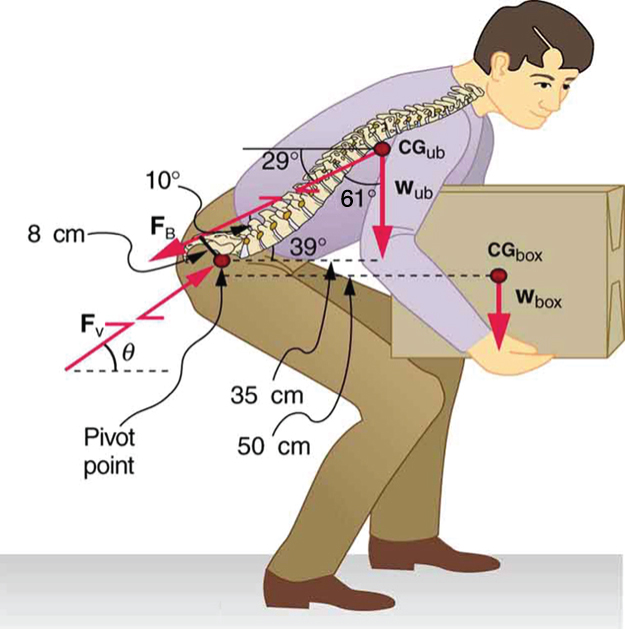
Figure: Center‑of‑gravity overlay on a gymnast balancing on a beam.
4. Kinetic Chain
Movements flow through a sequence of joint and muscle actions—from ground contact in the feet to force transfer up through the legs, core, and arms. Efficient chains maximize power output.

Figure: Phases of the running gait cycle demonstrating the kinetic chain.
Examples in Sports
High Jump: Uses angular momentum and optimal takeoff angle to clear the bar.
Tennis Serve: Sequential energy transfer—from legs → trunk → shoulder → racket—to maximize serve speed.
Swimming: Streamlining and minimizing drag, coordinating arm pull and kick for propulsion.
Why It Matters
Technique Enhancement: Identifies inefficient patterns for correction.
Injury Prevention: Reveals stress points and overload risks.
Performance Optimization: Guides training to develop power, speed, and endurance.
Equipment Design: Informs the creation of footwear, protective gear, and training aids.