
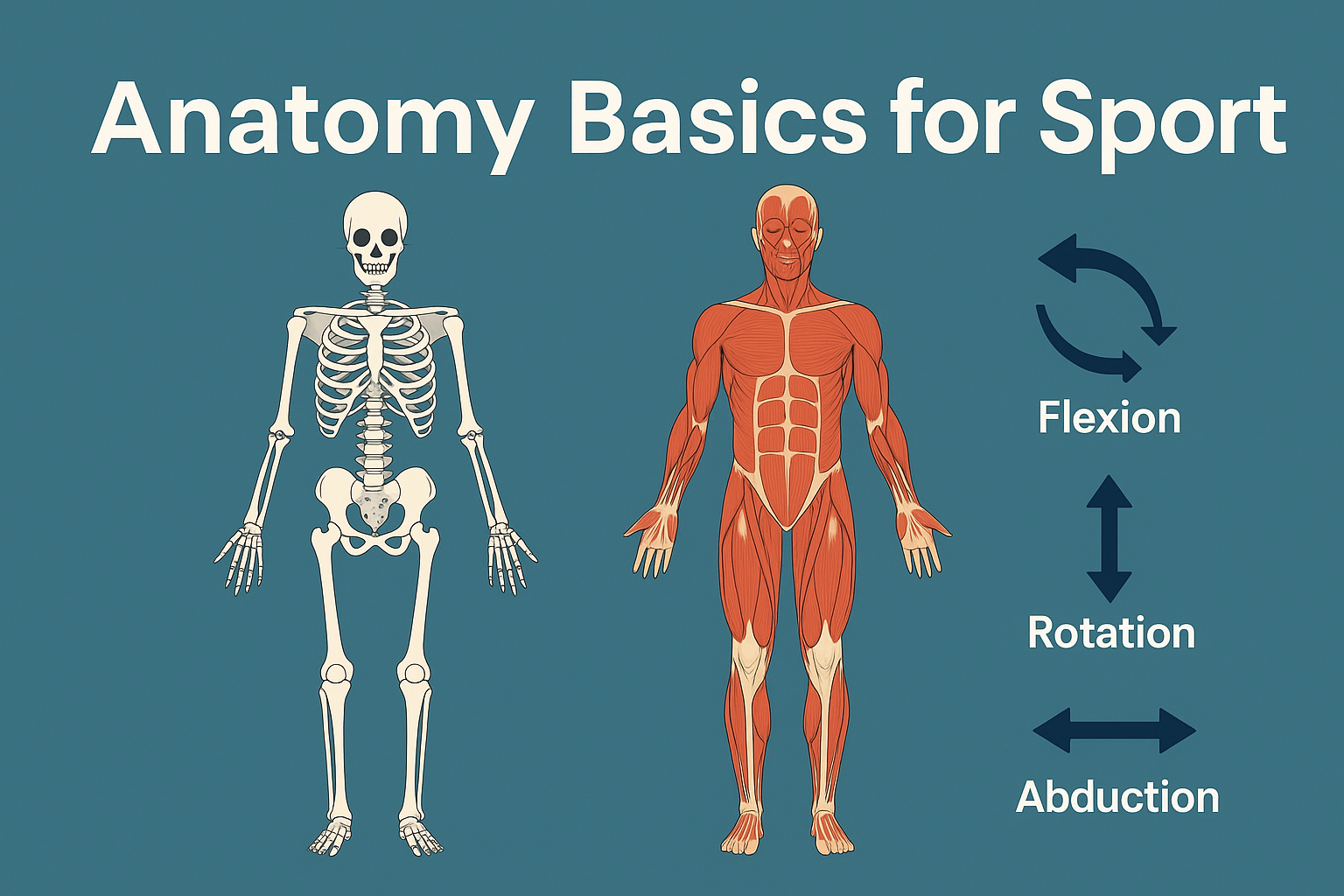

Anatomy Basics for Sport: A Primer
Understanding the body’s structure is key to optimizing athletic performance, preventing injuries, and designing effective training programs. This article covers the skeletal system, muscular system, and joint movements, with contextual diagrams embedded throughout.
1. Skeletal System: Your Structural Framework
The skeleton provides support, protects vital organs, and serves as the anchor for muscles. In sports, bone health and alignment influence power transfer, posture, and injury risk.
Figure: The major bones of the human skeleton (anterior view).
Key Points:
Axial skeleton: skull, vertebral column, rib cage. Stabilizes the torso and protects the brain, spinal cord, and heart.
Appendicular skeleton: shoulder girdle, pelvic girdle, limbs. Facilitates movement and force generation.
Bone remodeling: weight‑bearing exercise (e.g., running, jumping) stimulates bone density—crucial for long‑term joint health.
2. Muscular System: Generating Force
Muscles convert energy into movement. Major groups work in concert to produce powerful, coordinated actions—think sprinting, lifting, or kicking.
2.1 Superficial vs. Deep Muscles
Superficial muscles (near the skin) drive large, explosive movements.
Deep muscles (close to bones) stabilize joints and maintain posture.

Figure: Lateral view of the human muscular system showing superficial muscle layers.
2.2 Major Muscle Groups in Sport
Quadriceps & Hamstrings: knee extension/flexion—essential in running and jumping.
Gluteals: hip extension—power source in sprinting and squats.
Core muscles (abdominals, obliques, erector spinae): trunk stability—for balance and transfer of force.
Deltoids, Pectorals & Latissimus: upper‑body strength—for throwing, swimming, pushing.

Figure: Color‑coded front and back views of major muscle groups.
3. Joints & Movement: The Engine of Motion
Joints dictate the range and type of motion. Understanding joint mechanics helps athletes improve technique and reduce injury.

Figure: Common synovial joint movements—flexion/extension, abduction/adduction, rotation.
Primary Joint Types in Sport:
Hinge joints (e.g., knee, elbow): flexion/extension only.
Ball‑and‑socket joints (e.g., hip, shoulder): multi‑axial—allow flexion, extension, abduction, adduction, rotation.
Pivot & condyloid joints (e.g., neck, wrist): permit rotation and limited multi‑directional movement.
4. Bringing It Together: Functional Anatomy in Action
Squat: Hip (ball‑and‑socket) + knee (hinge) + ankle (hinge) must coordinate with gluteals, quadriceps, and calf muscles.
Throw: Shoulder and elbow joints synchronize with deltoids, pectorals, and triceps for power and control.
Plyometrics: Rapid stretch‑shortening cycles in leg muscles leveraging hip, knee, and ankle joints generate explosive force.